
Raising Puppies in a Behavioural Ecosystem
I’ve been thinking about writing about this topic for some time and recently came across a few photos and a video that prompted me to revisit the scientific literature on generational influence in dogs.
This video stars Stanley, now gone and missed every day, lying on a dog bed in our living room. A large litter of six-week-old puppies crawls over him, paws at his face, mouths his ears, and climbs across his shoulders. He has the freedom to leave, but he stays, unconcerned and relaxed. When necessary, he gently mouths a puppy or places a paw lightly across a small body to moderate intensity, at times with a bit of playfulness. There is no escalation or tension and he doesn’t withdraw. Stevie, the puppies’ dam (also gone and missed every day), is part of the action as well, engaging with the puppies and giving appropriate cues when they cross boundaries. Her style is more vocal than Stanley’s but her body remains relaxed as she mothers and directs them, exhibiting the same stable temperament as Stanley.
What struck me watching the video again was not how sweet it was, but how ordinary it feels in our home. This is simply how our adult dogs behave. It led me back to a question that has become central to how I think about aspects of our breeding program.
What kind of adult dogs do you want your puppies to grow up watching?
For years, much of the conversation around raising puppies has focused on structured protocols such as early neurological stimulation, novel object and sound exposure, early scent introduction, structured and intentional socialization activities, confidence-building exercises, and more. All of these have value, but puppies do not grow up in controlled exercises alone. They grow up in environments shaped by adult dogs and humans who they observe, reference, and absorb information from like little sponges.
Research supports three mechanisms through which this influence occurs: heritability of temperament, maternal effects, and social learning.
Heritability: Selection Shapes Probability
Temperament has measurable heritability. Large-scale behavioural datasets and working dog programs consistently demonstrate that traits such as biddability, fearfulness, excitability, and aggression show moderate genetic influence.
Ilska et al. (2017) reported measurable heritability estimates demonstrating that genetic variation contributes to temperament differences across dogs, reinforcing that behavioural tendencies are not purely environmental. Similarly, Arvelius et al. (2014) demonstrated that temperament testing “is an effective tool for selection of breeding animals with the goal to decrease everyday life fearfulness,” showing that behavioural traits respond to selective pressure across generations.
Heritability does not imply inevitability, but it does mean that selection matters. When breeders consistently select dogs who demonstrate emotional regulation, appropriate social tolerance, and recovery from stress, those traits shift in frequency over time. We are not attempting to guarantee outcomes. We are, however, making decisions and taking actions that shape probability.
For breeders, this reframes what we prioritize. Titles and structure are visible. Recovery time, startle response, proportional correction, baseline arousal, and social tolerance are equally real but less often documented. If we are serious about long-term behavioural outcomes, those traits must become part of our formal evaluation criteria, not just informal impressions. This is one reason we temperament test every litter, creating a dataset on each litter as well as trait profiles on every puppy. That process leaves us with a robust tool set upon which to base decisions. While temperament testing is often discussed as a matching tool for puppy families, it is also a data point within our breeding program. Patterns observed across litters inform which temperamental traits are consistently expressed, how they interact with structure and drive, and which individuals align most closely with our long-term objectives. Matching does not only occur between puppy and family, it also occurs between puppy and program. We are not only selecting for phenotype, we are also selecting nervous systems.
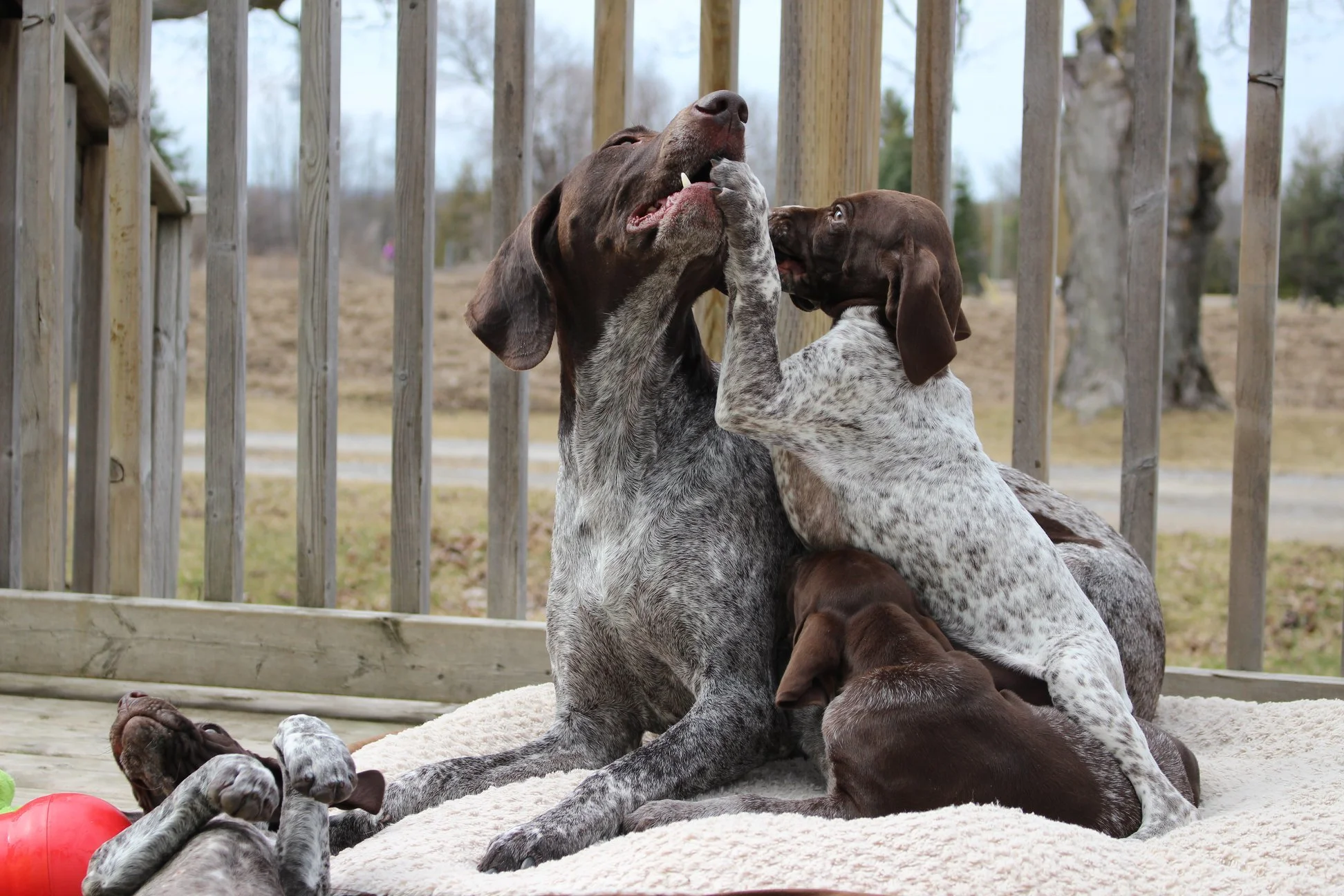
Stevie with several of her puppies
Maternal Effects: Influence Has Direction
Maternal effects add another layer. Research in guide dog populations, including the work of Bray et al. (2017), shows that variation in maternal style influences later behavioural outcomes. In their study, maternal investment predicted differences in behavioural and cognitive traits linked to guide dog success.
Importantly, the “ideal” maternal style is not universal. Bray and colleagues found that maternal behaviour influenced developmental trajectories, but those trajectories must be interpreted in the context of the program’s goals. A behavioural profile desirable in one working context may be less suitable in another.
Maternal behaviour does not produce universally better puppies, it influences direction.
This nuance matters. It suggests that breeding considerations are not simply about ensuring that a dam is attentive. They are about understanding what her style reinforces and whether that aligns with the goals of our program.
Stevie’s maternal style was engaged and communicative, but emotionally steady. She corrected without intensity and tolerated without suppression. That combination matters for the type of dogs we aim to produce. The decisions we make when choosing dams have a measurable impact on whether we meet our desired outcomes.
As Bray et al. (2017) noted, early maternal environment can influence traits that “predict success” in later working roles. That principle extends well beyond guide dogs. It applies to police and military dogs, search and rescue dogs, detection dogs, sport dogs, and just as importantly, to family companions. A puppy destined for a busy household with children, visitors, travel, and everyday unpredictability also requires behavioural consistency and resilience. The central takeaway is not that one maternal style is universally superior, but that it should align with the goals of the breeding program and the environments those puppies are most likely to inhabit.
Social Referencing and Observational Learning in Dogs
Research in canine cognition has demonstrated that dogs use social partners as informational resources. In ambiguous situations, dogs engage in social referencing, looking toward familiar individuals and modifying their responses based on observed emotional cues (Merola et al., 2012).
In experimental settings, dogs have been shown to acquire task-relevant information by observing conspecifics, a phenomenon described as visual social learning (Range et al., 2007). These findings suggest that behavioural responses, particularly those involving uncertainty or novelty, are shaped not only by individual experience but also by observed social models.
In breeding environments where puppies are routinely exposed to stable adult dogs, repeated observation of calm recovery, proportionate correction, and consistent engagement may contribute to the development of similar response patterns. While genetics and maternal effects establish foundational predispositions, social modeling provides ongoing contextual reinforcement.
Over time, this creates what can reasonably be described as a behavioural culture within a kennel.
Social Learning: Behaviour Becomes Cultural
The third mechanism is social learning. Dogs engage in social referencing, looking to familiar individuals when assessing ambiguous situations. Merola et al. (2012) found that dogs looked toward their owners in ambiguous situations and showed different behavioural responses depending on the emotional signals provided. Their results suggest that dogs use familiar humans as social references when interpreting uncertainty. Rather than assessing novel situations entirely independently, dogs appear to incorporate social information into their responses.
Range et al. (2007) further showed that domestic dogs are capable of “visual social learning,” acquiring information by observing other dogs perform tasks. In a multi-generational household, adult dogs are not background presence, they are behavioural models. When a puppy sees an adult recover quickly from a sudden noise, greet a stranger with neutral confidence, settle after excitement, or respond reliably to a cue, that response becomes information. Over time, patterns of regulation and response are normalized. Behaviour becomes cultural before it becomes individual.
Stanley’s tolerance under the physical chaos of a litter was not passive indulgence. It was inhibitory control and a stable nervous system under sustained stimulation. The puppies experienced consistent, proportionate feedback rather than volatility. That is a masterful lesson in boundaries and regulation delivered by a stable, well-adjusted adult.
Compounding Influence in Multi-Generational Systems
When stable adults raise puppies who then mature within that same environment, influence compounds. Genetic selection narrows the distribution of certain traits while maternal style reinforces specific tendencies, and ongoing exposure to regulated adult behaviour stabilizes social expectations. As genomic research has shown, “behavioural traits in dogs show significant heritability” (Ilska et al., 2017), meaning that consistent selection does, over time, shift the likelihood of certain temperamental tendencies emerging. At the same time, variation in early maternal care has been shown to correspond with variation in offspring behavioural outcomes. Bray et al. (2017) reported that variation in maternal behaviour was significantly associated with later success in guide dog training, and that early maternal investment corresponded with differences in offspring behavioural and cognitive development. When these forces operate together across generations, the result is not random, it is intentional generational influence. It is not accidental and it is certainly not achieved in eight weeks.
It is important to point out that the opposite outcome is also possible. Multi-dog households amplify what exists. Anxious adults model anxiety and reactive adults normalize reactivity. The presence of adult dogs alone is not beneficial. The quality of those adults and the intentionality of the environment determine the direction of influence.
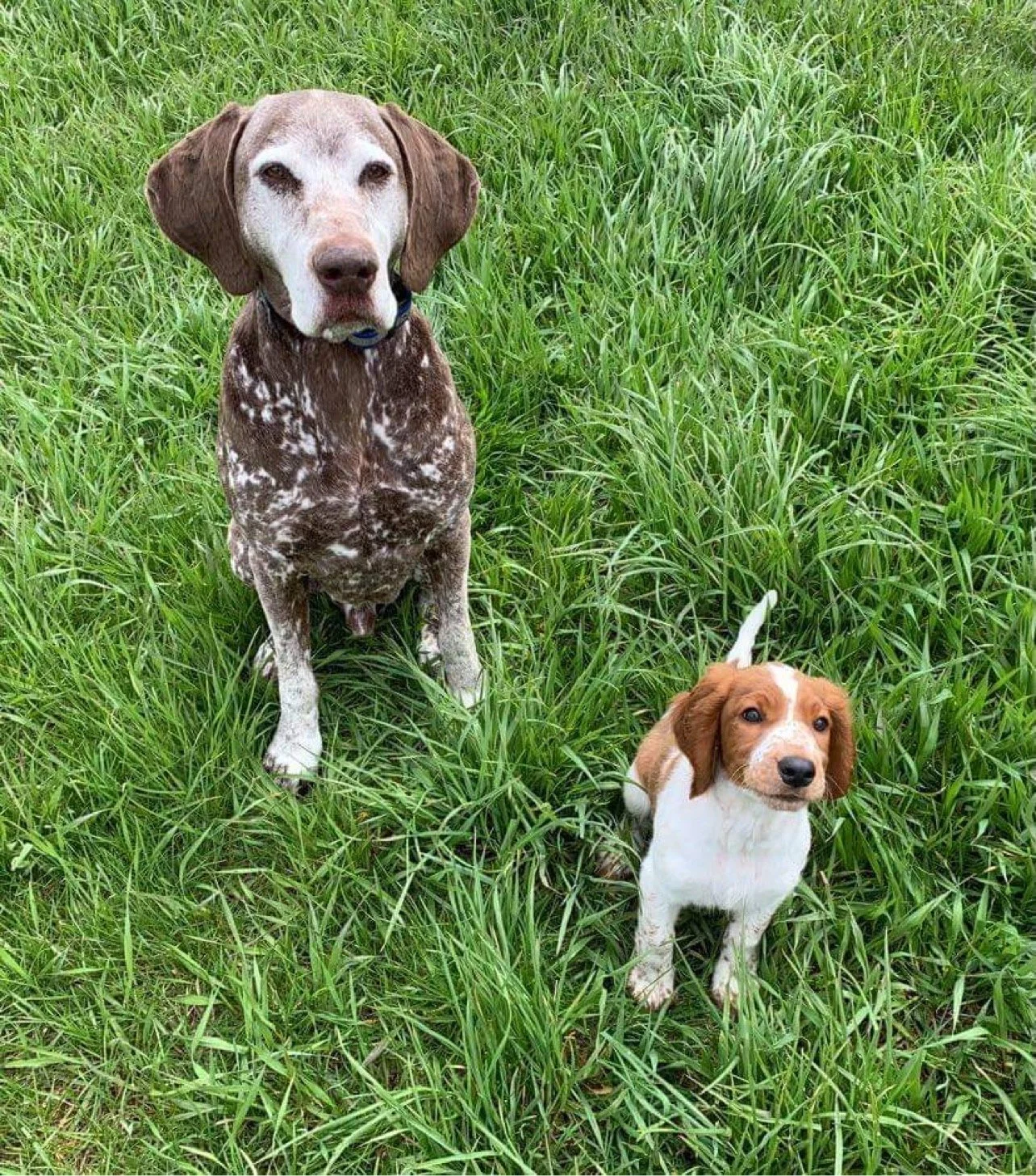
Stanley and baby Dylan 🤎🤍🧡
For breeders, this demands a systems mindset. We cannot evaluate breeding stock solely in isolation. We must evaluate how they behave within group dynamics, how they respond under sustained social pressure, and how proportionately they correct younger dogs. These traits influence both genetic transmission and environmental modeling.
For puppy families, the principle continues after a puppy leaves. Puppies watch the adult dogs in their new homes and they watch how their humans respond to stress and novelty. Emotional regulation is socially transmitted long before it is formally trained.
It is equally important to acknowledge that no dog is perfect and no breeding practices or approaches eliminate all challenges. Even with rigorous selection and stable adult influence, puppies require ongoing training, carefully planned socialization, and consistent guidance. Responsible ownership is a long-game pursuit. This reflection is not meant to replace enrichment protocols, training plans, or structured socialization. It is meant to highlight another important layer in shaping temperament, one that can enhance and more reliably predict a puppy family’s experience when foundational stability is already present.
There is no single study proving that puppies raised alongside calm adult dogs become calm adults themselves. What the literature does provide are the mechanisms through which that influence can occur. Heritability shapes probability while maternal style influences direction, and social learning transmits patterns of response. Together, these form a system.
Looking back at that video, what stands out is consistency. Stanley remained steady while Stevie corrected proportionately. The puppies experienced stability from multiple angles and over time, those repeated experiences matter. Over the years, we have worked deliberately to increase our knowledge and refine our skills so that our program aligns more closely with our goals. Stable, strong temperaments sit at the top of that list. We have consistently selected exceptional breeding parents, mothers whose styles reinforce the traits we value, and retained adults who provide a stabilizing, confident influence for our young puppies and adolescents. That consistency is not accidental. It is the result of intentional generational selection and the recognition that the adults in our home shape far more than pedigrees.
Exceptional puppies are not the product of enrichment exercises alone. They are born into carefully selected pedigrees and raised within behavioural ecosystems shaped by intentional generational influence.
So the question remains for breeders and families alike.
What kind of adult dogs do you want your puppies to grow up watching?
References
Arvelius, P., et al. (2014). Genetic analysis of a temperament test as a tool to select against everyday life fearfulness in Rough Collies. Journal of Animal Science, 92(11), 4843–4855.
Bray, E. E., et al. (2017). Effects of maternal investment, temperament, and cognition on guide dog success. Proceedings of the National Academy of Sciences, 114(34), 9128–9133.
Horn, L., Range, F., & Huber, L. (2013). Dogs’ attention towards humans depends on their relationship, not only on social familiarity. Animal Behaviour.
Ilska, J., et al. (2017). Genetic characterization of dog personality traits. Genetics, 206(2), 1101–1111.
Merola, I., Prato-Previde, E., & Marshall-Pescini, S. (2012). Dogs’ social referencing towards owners and strangers. Animal Cognition, 15(4), 699–709.
Range, F., et al. (2007). Visual social learning in domestic dogs. Animal Behaviour, 73(4), 595–603.