
Brian Gray: A Life Organized by Dogs and the Stories They Shaped
This is the first story in The Stannyfield Circle, a series sharing the lives and experiences of our Stannyfield families.
Brian and Deb Gray are the proud owners of Violet, from our Bishop x Smidge litter. While not yet published, Brian has written a book reflecting on life with his first German Shorthaired Pointer, Buck. It is his experiences with Buck, and now with Violet, that inspired this piece.
The Early Years
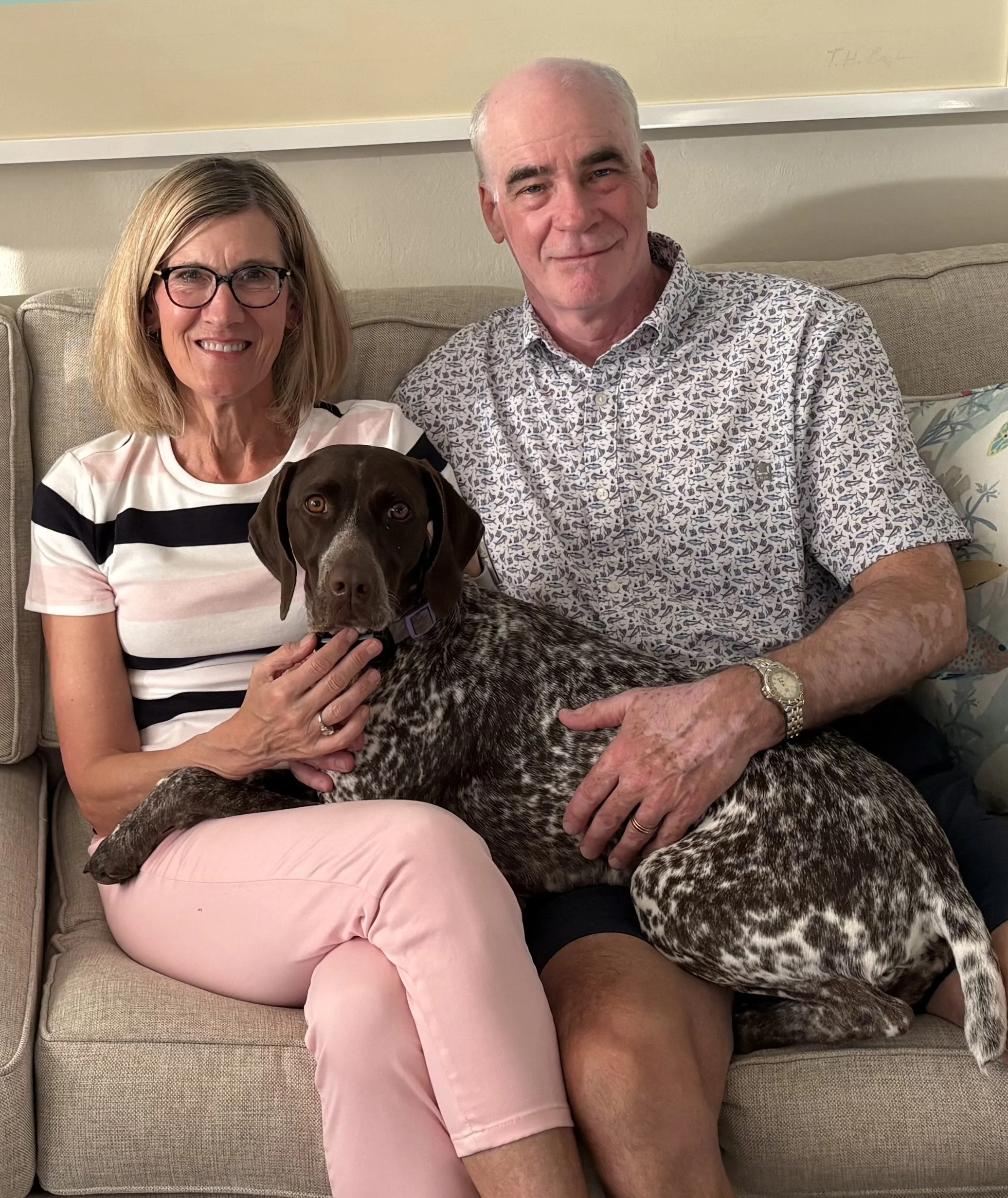
Brian, Deb, and Violet. Photo courtesy of Brian Gray.
One of Brian’s earliest memories was a matinee showing of Old Yeller. The movie changed his worldview. Not because of the ending, though that would leave its mark, but because it was the first time he remembers seeing the world in Technicolor.
Until then, his days unfolded in black and white. A school filled with black nuns’ habits, white shirts, dark uniforms, and black asphalt. On screen, a large yellow dog moved through a landscape alive with colour. It was the first time Brian understood what a dog could be—a protector, a companion, a steady presence against the uncertainties of the world. That idea settled in quietly and stayed.
During his adolescence, Brian didn’t think of himself as a storyteller. Public speaking, in fact, terrified him. But as he moved through high school he discovered that when he told stories, people not only listened, but genuinely enjoyed them. As friends asked him to retell those stories, he built confidence and nurtured his own unique storytelling style, many of which had a dog at their centre
Brian’s storytelling began with Buck, a bold, precocious German Shorthaired Pointer who entered Brian’s life at fourteen and never really left it. Buck, Brian’s first dog of his own, was supposed to be a hunting dog. He was meant to live outside in a doghouse and focus on hunting performance, not companionship. Brian, armed with equal parts curiosity and naivety, didn’t get that memo.
Learning to Tell the Story
If the first stories about Buck shaped Brian’s sense of self, it was in community that they found their purpose.
As a teenager and young adult, Brian found his voice not through speeches or formal settings, but through shared moments and retelling lived experience. Throughout high school and university, friends encouraged him to recount moments of mischief and adventure with Buck. Each retelling refined his sense of timing, detail, and humour. More importantly, it created connection.
After he finished school, he pursued a career that demanded clarity, precision, and authority. Yet even then, dogs remained a connective tissue in his life. When Brian met his wife Deb in the early 1990s, storytelling returned to the centre of his life in a different way. Deb came from a family of dog-loving cottagers, who spent summer evenings, glass in hand, telling stories. A family favourite was ‘a Buck story’. After years of enjoying Brian’s Buck stories, he was encouraged to write a book about Buck’s escapades. That was the first thing on Brian’s agenda upon his retirement.
Defying the Rules Without Meaning To
“Through equal doses of naivete and hard work, I proved that a very good hunting GSP could also be an excellent house dog and companion.”
When Brian first brought Buck home in the early 70s, he was met with a wall of certainty. Everyone thought they knew how a hunting dog was supposed to be raised. They were kennel dogs, livestock, not companions. Too much affection would ruin them, too many non-hunting-related words would confuse them, and a hunting dog in the house was unthinkable!
This philosophy was delivered most memorably by the family veterinarian, a gruff, chain-smoking self-proclaimed authority on the subject. Brian looked up to his veterinarian and soaked in his words. He then went home and did what felt right.
While not at first, Buck eventually lived in the house and learned more than a handful of non-hunting commands. He became a very good hunting dog and over time, and without intending to prove a point, Brian quietly dismantled the long-held belief of his vet and many experts that hunting dogs can’t be family pets.
Years later after Buck had passed, Brian ran into that same veterinarian in a grocery store. The man stopped him, admitted he had been wrong, and acknowledged that Brian had proven something important. A great hunting dog could also be a deeply bonded companion and house dog.
A Career of Responsibility and Return
“The stories were always there. I just hadn’t slowed down enough to nurture them.”
Brian’s formal training was in wildlife ecology. Armed with a PhD, his work carried him from the private and not-for-profit sectors into senior leadership roles within the Canadian public service. Over the course of sixteen years, he served as Assistant Deputy Minister and Chief Scientist across multiple federal departments, shaping policy in science and technology, environment, and natural resources.
It was demanding work, global in scope, and consuming in pace. When Brian was not travelling, he was working long hours in the office. When he was not working, he devoted his time to his family. Writing had little space in that chapter of his life.
Still, the stories and particularly those about Buck, persisted. During long-haul flights, Brian began jotting down fragments, chapter ideas, key phrases, and moments he didn’t want to forget. Slowly, a shape emerged, and he began to imagine that retirement might one day offer the time needed to pull those Buck stories together.
Once retired, Brian dove headfirst into writing about Buck. He wrote in the mornings, edited in the afternoons, and stayed disciplined. What began as scattered memories, turned into a humorous, touching story about a teenage boy and is loyal companion, a hunting dog named Buck.
Full Circle, Back to the GSP
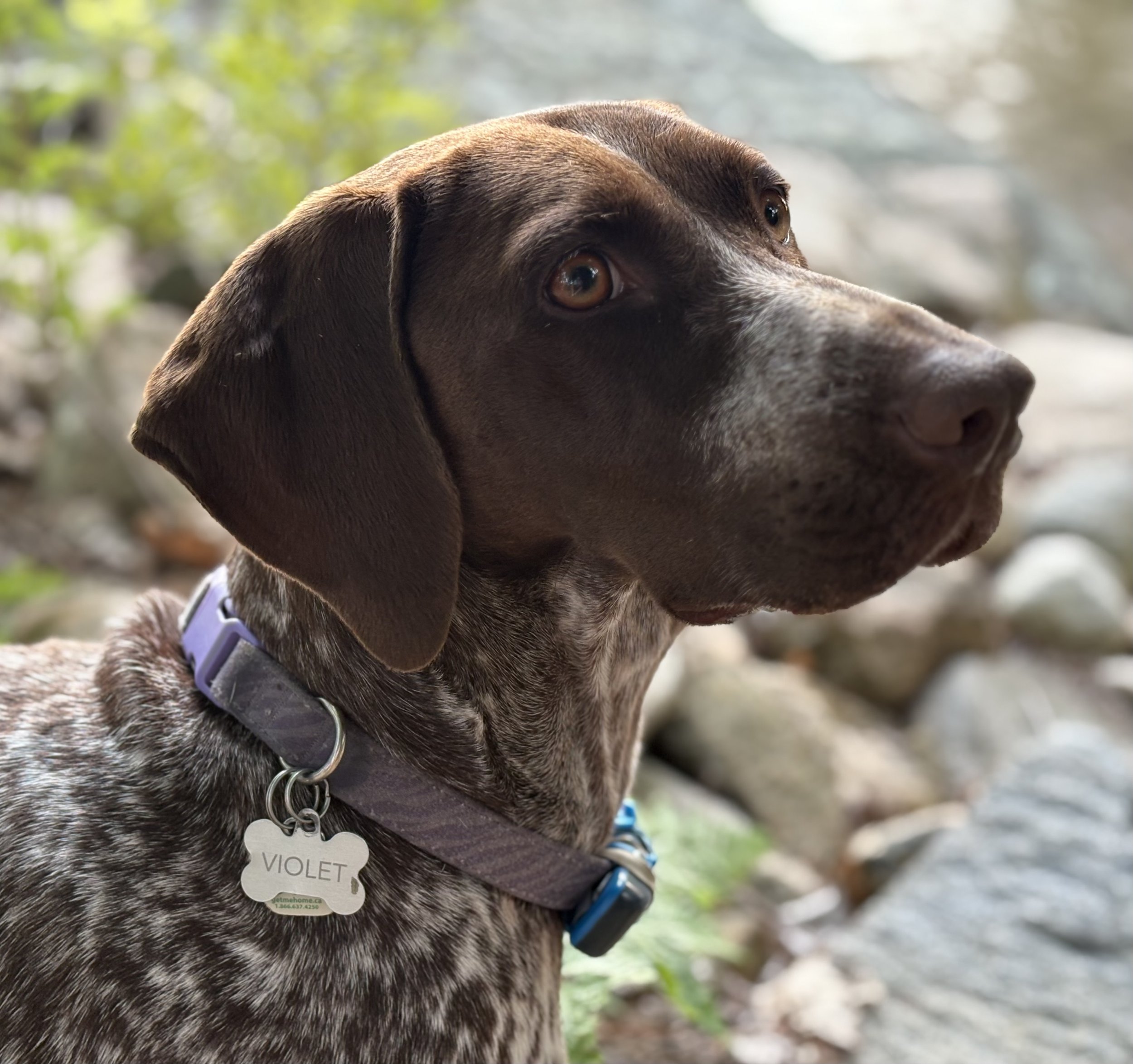
Beautiful Violet. Photo Courtesy of Brian Gray.
Throughout his life since Buck, Brian has owned and hunted over several Chesapeake Bay Retrievers and Weimaraners. Writing his book rekindled the idea of having a German Shorthaired Pointer in his life once again.
Enter Violet.
Violet joined Brian and Deb in early 2024 and has delighted them with her playful antics, snuggly affection, and yet another reminder of the breed’s remarkable duality.
Inside the house, Violet is affectionate, goofy, and deeply people oriented. She loves to play, roughhouse, parade around with her stuffed toys, and curl up on the couch at the end of the day. Outside, she is all business. Prey-focused and alert, she moves through the world with intensity and purpose. Through thoughtful, ongoing training, Brian and Violet have already shared successful hunts on upland birds and waterfowl. After laying such a strong foundation, there is little doubt that many good seasons lie ahead.
To Brian, Violet’s indoor and outdoor personas are not a contradiction, but rather the essence of the breed. German Shorthaired Pointers are often described as versatile, but that word hardly does them justice. Shorthairs are capable athletes, exceptional hunting partners, and enthusiastic participants in dog sports. They are also devoted companions who thrive on closeness and connection. The balance between these traits is not accidental. It’s what makes them so well suited to active people who want both partnership and presence.
Stewardship Over Ownership
For Brian, responsible dog ownership has always meant more than meeting basic needs. It is about cognitive stimulation, emotional connection, and respect for a dog’s instincts. For sporting breeds in particular, it also means providing opportunities to engage with what they were bred to do. That doesn’t always mean hunting, but it does mean movement, exploration in the natural world, and purpose.
Brian has learned, sometimes the hard way, that not every trait can be trained away. Prey drive is not defiance; it is wiring. Understanding that distinction has shaped his approach over time, replacing frustration with patience and control with collaboration. Every dog is an individual, with a unique set of traits that should be incorporated, not fought.
What Dogs Leave Us With
Brian hopes his book brings joy, invites reflection, and encourages readers to reconsider what they think they know about dogs, about hunting, and about the quieter relationships that shape a life over time. Like many first-time authors, Brian is navigating the realities of today’s publishing landscape. While there is clear interest among sporting dog enthusiasts, building a visible readership and digital presence has become an important part of the process.
In response, Brian has turned his attention to building a digital presence that reflects what matters most to him—dogs, nature, storytelling, and the relationships that form when those things are shared. Violet remains a daily companion in that work, not just as a subject, but as a reason to stay curious, to step outside, and to pay attention.
In the end, dogs are not the only way Brian understands his life, but they have often been the lens through which connection came into focus. Through dogs, friendships deepened, family gathered, conversations opened, stories were told, retold, and eventually written down.
A final note: Brian’s book is currently unpublished, and he’s taking a thoughtful, measured approach as he builds his social media presence.
For readers who’ve enjoyed this story and would like to follow along, Brian shares more of life with Violet on Facebook and Instagram. You’re welcome to follow Violet the GSP there for glimpses of their everyday adventures.
If you’re curious about the book as well, Brian is always glad to hear from readers. A direct message through Violet’s social accounts is the easiest way to get in touch.